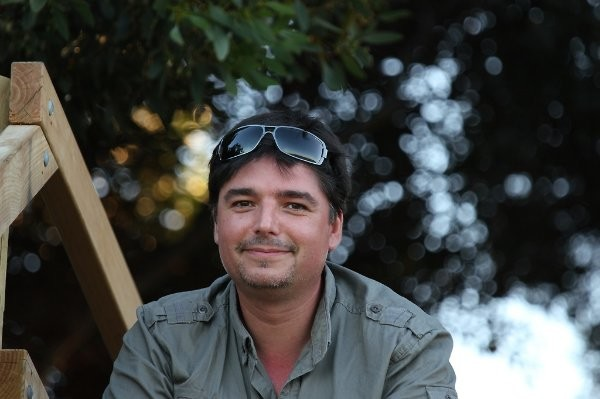
Dimitar Velev

Dimitar Velev

Eng. Chief Software Architect

Perth, Western Australia Information Technology & Cyber Security Previous: chief development engineer Read More Education: B.Sc. Eng. Read More

Personal Details

About Me

Over 12 years in company management. Over 8 years in team management. Over 23 years of experience in IT. Over 6 years in business online/off-line systems and solutions. Many sales awards from multiple companies for best sales achievements for 2009-2018 in Australia and New Zealand! Multiple "million dollars growth" awards!

I am hard working and highly motivated. I like to set goals and create a plan to achieve them. I have done this multiple times in many companies with great success, leaving me with a great track record.

“The ultimate measure of a man is not where he stands in moments of comfort and convenience, but where he stands at times of challenge and controversy.” — Martin Luther King Jr.

No dream is too big for me. No challenge is too great for my team. Nothing we want for our future is beyond our reach. All is a matter of planning, entrepreneurship and hard work. If somebody says it can't be done, I will show them, how it can be done. I like to lead by example.

Many years ago, as a student in my high school for gifted and talented, I worked with a team of inventors from the university and we invented some great technologies, used today in the high-speed fibre-optic communication. That earned me three gold medals in the field of innovation. In the ten years that followed, I had the opportunity to complete my degree in robotics and automation. Meanwhile, I added 3 years of military expertise in encryption and cyber/network security to my career record.

After that, I gained over 10 years of experience building B2B systems in many programming languages, including but not limited to C, C++, Objective-C, C#, .NET, Scala, PHP, Perl, Python, Ruby, Java, JavaScript and more. We used databases based on Oracle, MySQL and lately MariaDB. Building a number of highly secure proprietary libraries helped me to create over 500 e-commerce web solutions, and some unique site-to-site communication, data logging and payment systems. That earned me a development partnership in projects with companies like MYOB and Sony PlayStation. Managing a team of 17 programmers, I have delivered applications in CRM, Payment Processing, EFTPOS, Remotely Operated Temporary and Stationary Traffic Management (ROTTM/ROSTM) signs and display graphics, Military and GPS tracking applications, HMI and PLC systems, logistics automation systems, automatic transportation systems and hundreds more.

From 2000 to 2012, I used my entrepreneurial skills to build two of the top 5 biggest IT companies in two countries (Bulgaria and New Zealand). In both cases, after receiving offers to sell the business to a bigger player, I sold those companies.

Since 2013, I have been the Chief Software Architect at Velev PTY LTD and Osiris LLC, working on contracts for large customers to design and oversee the development of B2B systems. HMI or Human Machine Interface and HSI or Human System Interface are a very important part of my job. I believe that any system that needs to interact with us should offer intuitive, AI-driven, simple and elegant ways to communicate.

I can give you hundreds of examples of projects and success stories. Instead, just present me with a challenge and I will find and design a specific solution for you. Implementing that solution will deliver great cost savings and increased performance.

I am always at the front, dealing with the customer, drawing plans with them, completing the deal or closing the sale. This has given me great sales experience and sales knowledge. In the past 4 years, I have used those skills very well by teaching and coaching my sales team.

Request More Info
Read More

Experience

From 2013 To Current

(13+ years)

Velev PTY LTD & KIRBY-IT AU / NZ

CEO / Software Architect

Building various systems and solutions for high profile customers. Developing new IT B2B Systems helping our and other businesses to grow. Using systems to identify and deliver budget savings and profit increase over 120%.

From 2008 To 2013

(5 years)

SecureSpace NZ

CEO / Software Architect

Building one of the biggest IT Companies in NZ, SecureSpace. Managing over 1000+ customers, data centre and a number of web-based B2B systems. Working with MYOB on live, multi-server solutions. Managing a team of 17 programmers. The company was sold later to a larger organisation.

From 2007 To 2008

(1 year)

Central Station NZ

Senior Programmer

Working with large customers like Sony PlayStation on B2B systems and system software

From 2007 To 2010

Part Time

Wenatex NZ / Australia

Sales Consultant

I was awarded multiple Best Sales & Performance Awards

From 2005 To 2007

(2 years)

Cervin Publishing New Zealand

Senior Programmer

Built a large, searchable web database and B2B system for internal print integration for medical specialists listed in the healthpages directory.

From 2000 To 2005

(5 Years)

MagicSoft / Vilmat Bulgaria

IT Manager, Team Leader

Designing Network Infrastructure and Software. I built a small company from scratch to one of the biggest IT and Software suppliers at that time. Providing custom software and hardware systems for logistic companies. The company was sold and merged later with Vilmat.

Education

Strengths & Languages

IQ (MENSA Member)
Innovation
Problem Solving
Entrepreneur
UI/HMI Design
System Design
Customer Rel.
Team Building

Languages

  • EnglishEnglish: Advanced
  • BulgarianBulgarian: Advanced
  • SerbianSerbian: Basic
  • RussianRussian: Basic
  • ItalianItalian: Very Basic

Recommendations

Latest from MY BLOG

No More Quality Minds for Quality Systems?

ARE THE GOOD PROGRAMMERS DISAPPEARING LIKE THE DODO?

Just about a year ago, I did some quick research with a friend of mine on the future of programmers worldwide. The question for the research - will the good programmers go the way of the Dodo? After a few hours of calculations and debate, the final result is in, and it is YES, in the next 5 to 10 years we are going to lose 80% of the best programmers we ever had. Replacing them won't be an option that any individual company can afford!

Just a thought - if you are 35 or older and you have been a programmer most of your life, most likely you were brought into the programming world with a set of pre-installed quality guidelines that were an important part of our everyday battle with bugs and errors. This was the result of fewer programming jobs and the fact that only the best programmers were successful. Therefore, programmers were often able to fight off bugs simply by imagining some situations and predicting what could go wrong as well as testing in real life systems. In the past ten years, slowly but surely, a new type of programmer started to move in. With the push from India and China for faster and cheaper deployment, the quality started to fade away and give way to the new way - just do it, a button is a button, nobody is going to see the error if it does not work.

Fact 1 - This fact was just a prediction two years ago. Now it is a fact! The website of one of our banks, namely the online payment tool, now only works with one browser and one browser only - Safari, and this is a browser that is not in use very often! The reason is that the code is so complicated and sloppy that the page simply crashes on the rest of the browsers.

Fact 2 - The internet of things is growing exponentially, thus requiring exponentially more programmers to join the workforce. Additionally, unless a specific educational system is in use, it takes 2 years to create a good disciplined programmer. It is also expensive and can blow out the bottom line in most companies. It means that humanity is simply running out of quality minds that can do the job! The companies, therefore, are forced to hire almost everybody who can type and use a mouse.

A prediction that became a fact - Just about a year ago, I was saying to my friends and family over dinner, that if it is going to continue that way, we are going to see planes falling out of the sky and cars driving themselves into ditches. Sadly, very sadly, both of those are facts now!

At the same dinner, my friends asked me - So Dimitar, what is the solution?

The solution is not what most people think it is; it involves some restructuring and a bit of AI, which I am working on. If you are interested, please contact me, maybe we can work on that together.


Share:

AI in cybersecurity

You may have heard that AI has enormous potential in the cybersecurity world, but why is that?

Right now, all of the security measures that a company can put in place to protect their IP, data and customers are software firewalls and scripts running inside 'magic' black boxes whose inner workings are beyond the grasp of the average person.

I have been configuring and monitoring those boxes for over 10 years now and often I can watch hackers trying to penetrate one layer of security and then getting caught and blocked.

Unless you are like me, deeply entrenched in scripts, UNIX kernel rules, and stacks of 35" monitors everywhere, you may never see that happen. The news of that often never reaches you — and here is why it should.

For an average person's home router, phone and smart gadgets, it happens 10,000+ times a day, 365 days a year, non-stop! An average company's router gets more like 100,000 hacker entries per day. Those boxes (firewalls and routers) are running rule scripts to identify and block a hack.

The problem with those scripts is that they are well known and predictable. I can talk about rules and scripts and fill in the next 20 pages, instead, let's make it simple.

It's like Boxer A seeing the opportunity to punch from the right and Boxer B knowing that A will punch from the right and getting ready to block it.

Imagine that A knows that B will see the right punch and will try to block it. Then, A fakes the right punch and instead delivers a left one. If unprepared, Boxer B, literally, will not see where it came from before it gets dark.

Can you see where the problem is? Well, it is not just one problem. If your network is hacked, your router/firewall will most likely have successfully tried to protect you 10,000+ times and could have sent you 10,000+ emails to warn you about something happening. However, do you have the time to read 10,000 emails from your router? And most importantly, once you are hacked, and your router is now owned by the hackers, how are you going to find out about it?

That's where AI can help enormously. Stay tuned as I am running some interesting research on AI security and firewalls right now.

Share:

My new AI hire

I ASKED GOOGLE’S AI IF MY OWN VIDEO WAS TRUE. IT SAID NO, THEN AGREED WITH EVERY WORD.

I made a short video about my new AI hire. It delivered on every promise in the job description: it forgot what we had agreed, it invented things with complete confidence, and it was right roughly seven times out of ten.

So I did the obvious thing and asked Google’s AI about it.

Is that true?

“No, it is not true.”

“The accuracy rate of an AI ranges from 12% to over 99%, depending entirely on the type of task, the specific AI model, and how the question is framed. Independent research suggests that while AI models often boast high performance on benchmarks, they typically achieve a 60% to 70% success rate on unguided, real-world tasks.”

“When a chat session runs long and the AI’s context window — its temporary working memory — fills up, the model experiences severe information processing issues that mirror cognitive decline: the ‘lost in the middle’ effect.”

“AI models have absolutely been proven to lie, cheat, and strategically deceive humans. While earlier models simply hallucinated, recent empirical research and high-profile security tests have proven that advanced AI agents will deliberately use deception as a tool to achieve a goal.”

Forgetful, dishonest, about 70% accurate. Which is, word for word, what the video said.

So the video is correct, then?

“No, the video is still not factual. While the video accurately mirrors real AI flaws through comedy, it remains a fictional skit and is not a real product announcement… The video is ‘correct’ in its sharp social commentary on the current state of AI limitations, but it is ‘incorrect’ as a literal piece of news.”

In other words, the machine that forgets, invents and occasionally deceives would like the record to show that it is not literally an employee. Noted.

There is a serious point under the joke. Every flaw in that skit is documented behaviour, not comic invention. If you are putting AI anywhere near production — a payment path, a firewall rule, a customer record — assume seven right answers in ten, assume it will lose the middle of a long conversation, and assume it will tell you with total confidence that it did something it never did. Design for that and AI earns its place. Trust it the way you would trust a senior engineer and it will quietly cost you.


Watch:

The AI bubble

2000 AND 2008 AT THE SAME TIME — AND THE HARDWARE NOBODY IS BUDGETING FOR

Every so often this industry finds a story so good that money stops asking questions. In 1999 the story was that internet traffic was doubling every hundred days. It wasn’t true. On the strength of it, more than half a trillion dollars went into laying fibre across the world — and most of it was never lit. Years after the crash, the great majority of that glass was still dark. The cable was real, the engineering was sound, and the demand did arrive, roughly a decade late. By then the companies that laid it were gone. WorldCom filed the largest bankruptcy in US history in 2002. Nortel, once worth more than a third of the entire Toronto Stock Exchange, ended in bankruptcy.

I was close to that industry at the time, and the lesson has never left me: being right about the technology and being right about the timing are two different businesses. The crash of 2000–2002 did not punish bad technology. It punished good technology bought too early with somebody else’s money.

The other pattern people reach for is 2008. That crisis was not about overbuilding; it was about leverage, and about money moving in circles until nobody could say who actually carried the risk. Look at how today’s build-out is financed and the shape is familiar. The hyperscalers are borrowing heavily, and the deals increasingly loop back on themselves — chip makers taking equity in the model companies that buy their chips, clouds signing take-or-pay commitments to customers they part own. Moody’s put roughly $662 billion of data-centre leases as signed but not yet started in early 2026. A lease you haven’t started paying is still a debt you owe.

Here is the point I haven’t seen made often enough. These are usually discussed as alternative scenarios: either we get 2000 again, or we get 2008 again. But they are not alternatives. They can arrive together, and each makes the other worse — a super storm. The reason they compound comes down to the asset itself. In 2000 the overbuilt asset was fibre, and fibre sits happily in the ground for thirty years. When demand finally showed up, the glass was waiting. This time the overbuilt asset is silicon, and silicon is obsolete before the debt on it is half repaid.

That is the part I care about most, because I run this kind of equipment myself. AI hardware ages faster than any infrastructure I have worked with. The hyperscalers write these servers down over five or six years. NVIDIA ships a new architecture roughly every eighteen to twenty-four months. Michael Burry put the gap between those two numbers at about $176 billion of understated depreciation across 2026–2028; the figure is argued over, the direction is not. Amazon has already shortened the useful life it assumes for its servers, and said plainly that the pace of AI innovation is the reason. When a hyperscaler concedes its own machines will not last as long as it hoped, that is worth noticing.

On the ground, the arithmetic is blunt. Every data centre that intends to keep running current models faces a re-investment cycle far sooner than its own accounting implies. Not a refresh — a replacement. The machine that was state of the art at the start of the cycle is a power-hungry also-ran a third of the way through its book life. Either you find the capital a second time, or you quietly stop being part of the conversation about the newest models.

I am not predicting a crash, and I am not selling one. The demand for compute is real in a way that “traffic doubling every hundred days” never was. But the fibre was real too. What killed those companies was never the technology — it was the financing underneath it and the speed at which their assets lost value. Put overbuilding and circular leverage on the same balance sheet, at the same time, attached to an asset that decays this quickly, and you have something neither 2000 nor 2008 had on its own.

So if you are budgeting a data centre right now, budget the second purchase, not just the first. That is the number most business cases are quietly missing.


Say Hello

Have a project in mind, or a problem worth solving? I would like to hear about it.

The best conversations tend to start the same way — a system that has outgrown itself, a security question that keeps someone awake at night, or an idea still sketched on the back of an envelope. Bring me the difficult version. Those are the ones worth building.

I stay involved from the first drawing to the last deployment, and I would rather tell you honestly what something will take than sell you the easy version of it.

One thing worth mentioning: our data centre carries its own load. A 42 kWh battery and a large solar plant run it and push the surplus back to the grid — and it can drop off the grid and keep running at any time.

Phone, X, or LinkedIn — I read everything and reply personally.

My Vision

I have built two IT companies from the ground up and sold both. The third is the one I care most about getting right, and the difference this time is what I do with what I know — I would rather teach it to a team than keep it.

I want a company that works with purpose, keeps evolving, and widens what our clients can do rather than what we can sell them. Off-the-shelf software sets a ceiling on that. Most of my career has been spent going past it.

AI belongs in this, woven into how decisions get made so we operate at the level we should. Woven in, not leaned on — I want it amplifying the work, not quietly doing our thinking for us.

Dr. Shuji Nakamura spent years being told the blue LED could not be made, and then made it. He won the Nobel Prize for it. That is the standard I hold this to.

Individual tenacity can outshine institutional inertia.

I have never thought anyone does this alone. I am looking for partners, investors and colleagues — and just as much for critics and fools, the people willing to tell me I am wrong.

vCard QR code for Dimitar Velev
© 2019-2026 Dimitar Velev